

The Client: A Global Leader Preparing for a Hydrogen Future
The fischer group is a worldwide specialist in precision metal manufacturing, producing high-performance stainless-steel tubes and components for automotive, aerospace, medical, and industrial applications. Their capabilities span engineering, prototyping, automated large-scale production, and materials expertise in stainless steel, titanium, and nickel-based alloys.
Beyond their leadership in components for internal-combustion vehicle exhaust systems — where they supply major global OEMs — the same competencies are increasingly essential for emerging hydrogen technologies, where materials must withstand demanding gas and pressure conditions.
The fischer group is also a shareholder and strategic partner of GRZ. Together, GRZ and the fischer Innovation Center have strengthened the industrialization of metal-hydride cell production through advancements in welding, sourcing, and automation. This collaboration has been pivotal in enabling GRZ to scale its technology for the accelerating hydrogen market.
The Challenge: Managing Significant Peak Energy Loads
The Achern manufacturing site includes highly energy-intensive processes — particularly aluminum hot-forming, which produces short, sharp electrical demand spikes. These events resulted in:
- Significant peak-demand surcharges
- Operational stress on the local grid connection
- Underutilized surplus hydrogen produced on-site
The fischer group sought a solution that could simultaneously:
- Mitigate rising peak-power costs
- Store surplus hydrogen safely and efficiently
- Strengthen long-term energy resilience
The Solution: A Dual-Function Hydrogen-to-Power Asset
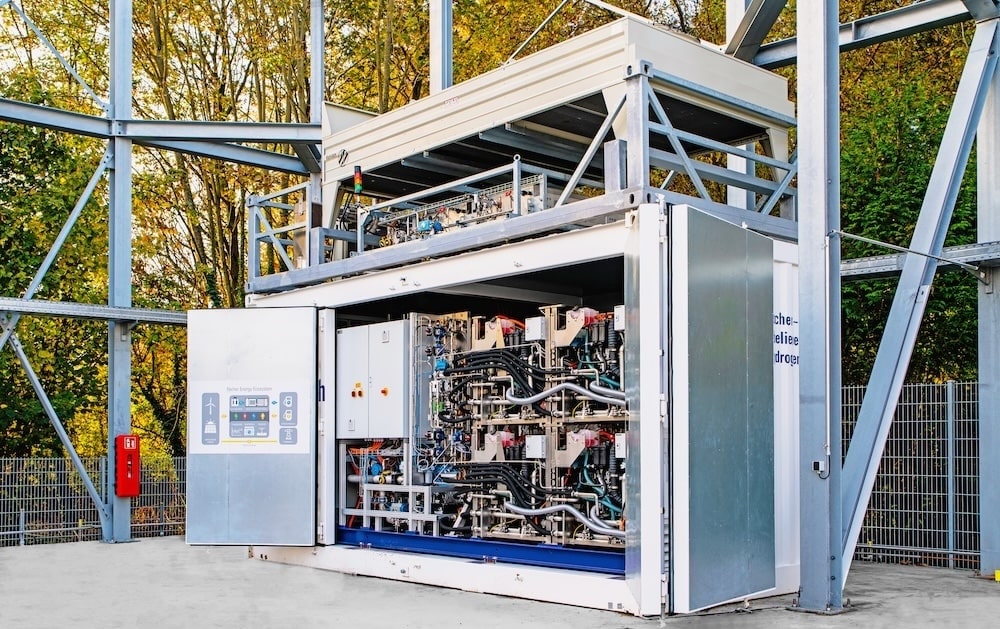
GRZ delivered the DASH Power 500–3500, a containerized system designed to perform two critical functions:
- Solid-state hydrogen storage (DASH)
- High-efficiency fuel-cell electricity generation
1. During normal operation:
The system absorbs and stores surplus hydrogen in GRZ’s solid-state metal-hydride technology.
2. During peak-load events:
The fuel cell instantly converts stored hydrogen into electricity, supplementing grid power and flattening the peak.
This dual functionality turns hydrogen into a financial asset, reducing peak-demand penalties while increasing the site’s energy flexibility.
The Results: Immediate Operational Value & Long-Term Strategic Fit
By reducing the site’s peak electricity draw, the DASH Power unit has lowered associated surcharges and provided immediate financial benefit. The system’s fast response time and stable output ensure predictable performance during the most demanding cycles.